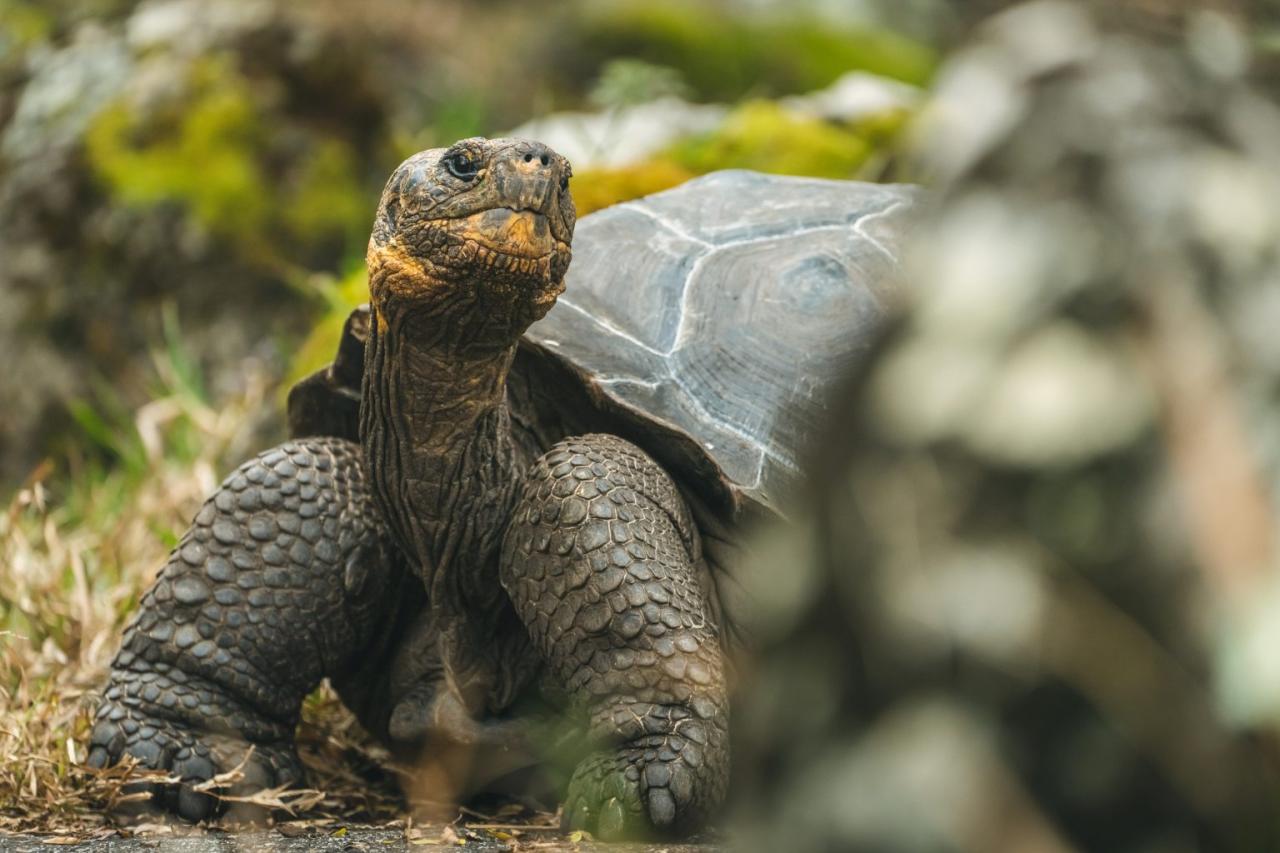
For more than one hundred years, the scientific community had quietly accepted a heartbreaking truth: the Fernandina giant tortoise (Chelonoidis phantasticus), native to the remote volcanic slopes of Fernandina Island in the Galapagos archipelago, had vanished forever. First documented in 1906 by explorer Rollo Beck and his team, only a single male specimen had ever been collected. Decades of subsequent expeditions returned empty-handed. No tracks. No droppings. No shells. The species was listed as extinct, a silent victim of whalers, pirates, and invasive species that had devastated tortoise populations across the Pacific.
Then, in 2019, something extraordinary happened. A joint expedition between the Galapagos National Park Directorate and the U.S.-based NGO Galapagos Conservancy stumbled upon an elderly female tortoise hiding in thick brush and volcanic fissures on the island’s western slopes. Small in stature compared to other giant tortoises, with a distinctive saddle-shaped shell and elongated neck, she matched the 1906 holotype almost perfectly. Genetic tests would later confirm what conservationists dared only to whisper: Chelonoidis phantasticus was not extinct. It had been hiding in plain sight, clinging to life in one of the most hostile and inaccessible terrains on Earth.
This article rewrites and expands upon the original discovery story, adding critical context, step-by-step scientific validation, and the ongoing efforts to save a species that has risen from the grave. You will learn not just what happened, but why it matters for biodiversity, conservation genetics, and the future of endangered species worldwide.
A. The Lost Fernandina Giant Tortoise: Historical Background
To understand the magnitude of this rediscovery, one must first appreciate the unique evolutionary theater of the Galapagos Islands. Located roughly 1,000 kilometers west of mainland Ecuador, this volcanic archipelago inspired Charles Darwin’s theory of natural selection. Among its most iconic residents are the giant tortoises (Chelonoidis spp.), which once numbered in the hundreds of thousands across 15 different species or subspecies.
Fernandina Island, the youngest and most volcanically active in the chain, has always been a harsh mistress. Its surface is covered in sharp aa lava flows, spiny cacti, and dense thickets of brush. Unlike neighboring Isabela Island, Fernandina never developed permanent human settlements. However, it did not escape human interference entirely.
During the 18th and 19th centuries, buccaneers and whalers routinely stopped at the Galapagos to capture live tortoises. These animals could survive for over a year without food or water, making them the perfect source of fresh meat on long voyages. Estimates suggest that between 100,000 and 200,000 tortoises were removed from the archipelago during this period. While Fernandina was less visited due to its difficult terrain and lack of fresh water, it was not immune.
The only confirmed Chelonoidis phantasticus specimen a large male was collected in 1906 by the California Academy of Sciences expedition. That animal’s shell, now preserved in a museum, became the species’ ghostly avatar. For generations, every follow-up survey failed to find another individual. By 1996, the IUCN Red List officially declared the species “Critically Endangered (Possibly Extinct).” By 2015, most biologists used the shorter, more brutal term: “Extinct.”
B. The Discovery: February 2019 – A Snapshot in Time
The rediscovery did not happen by accident, nor did it happen quickly. It was the result of a carefully planned, multi-institutional effort to survey Fernandina’s biodiversity using modern tools. The expedition team included rangers from the Galapagos National Park Directorate, researchers from the Galapagos Conservancy, and geneticists from Yale University.
B.1. How They Found Her
The team deployed a combination of ground searches, camera traps, and even trained scent-detection dogs a novel approach for reptile surveying. For the first ten days, they found nothing. The volcanic terrain was punishing. Temperatures soared past 35°C (95°F). Several rangers suffered cuts from razor-sharp lava.
On the eleventh day, a young park ranger named Jeffreys Málaga noticed a patch of disturbed soil near a collapsed lava tunnel. Following a faint trail of tortoise feces surprisingly fresh he crawled through a narrow gap in the rocks. There, half-buried in leaves and volcanic dust, sat a female tortoise estimated to be over 80 years old. She was not moving quickly, but she was very much alive.
The team carefully measured, photographed, and took a small blood sample from the tortoise. They named her “Fernanda” after her home island. Weighing just 28 kilograms (62 pounds), she was significantly smaller than the 1906 male specimen, which had weighed nearly 40 kilograms. This size difference, however, was consistent with sexual dimorphism and the harsh island environment.
B.2. Immediate Challenges
Fernanda was immediately removed from the wild strictly against standard protocol for endangered species rediscoveries. Why? Because Fernandina Island has an active volcano, La Cumbre, which had erupted violently in 2018 and again in early 2019. Thick ash clouds and sulfur dioxide emissions posed an immediate threat to any surviving tortoises. Furthermore, invasive black rats, fire ants, and feral cats have established populations on parts of Fernandina. These predators are known to destroy tortoise eggs and kill hatchlings.
The team made the difficult but defensible decision to airlift Fernanda to the Galapagos National Park’s giant tortoise breeding center on Santa Cruz Island. There, she would be protected, studied, and eventually if possible matched with a mate.
C. Genetic Confirmation: The 10-Month Wait Between Discovery and Declaration
Between February 2019 and December 2019, the scientific world held its breath. A single female tortoise had been found, but was she truly Chelonoidis phantasticus? Many experts suspected she might be a hybrid or a vagrant from Isabela Island’s neighboring Volcán Wolf tortoise population. Hybridization among Galapagos tortoises is common, especially in areas where humans have moved animals between islands.
To settle the question, Yale University’s genetic laboratory led by Dr. Gisella Caccone a world authority on Galapagos tortoise genomics performed high-resolution DNA sequencing. They compared Fernanda’s mitochondrial and nuclear DNA against the 1906 museum specimen and all 14 other known tortoise lineages.
The results, published in Communications Biology in June 2021, were unambiguous: Fernanda’s genetic material clustered tightly with the 1906 holotype and formed a distinct branch separate from all other living tortoises. Her genome also showed signs of low heterozygosity meaning she came from an extremely small, inbred population. This was both a confirmation of species status and a warning sign of severe genetic fragility.
The paper concluded that Chelonoidis phantasticus was not extinct, but it was functionally one step away. With only one confirmed living individual, the species is currently “extinct in the wild” or, more accurately, “surviving as a single captive female.”
D. Why Did It Take So Long to Find Fernanda?
The question on many people’s minds is simple: How does an animal the size of a large suitcase go missing for 113 years? The answer lies in three interconnected factors:
-
Extreme Volcanic Terrain – Fernandina Island is covered in overlapping lava flows from more than 30 historical eruptions. These flows create a labyrinth of tunnels, crevices, and razor-sharp clinkers. Human foot travel is slow, dangerous, and easily redirected. Tortoises, with their low metabolic rates and ability to go months without food, can hide in these lava tubes indefinitely.
-
Low Population Density – All available evidence suggests that Chelonoidis phantasticus was never abundant. Even in 1906, the expedition team reported seeing only a handful of individuals. The species likely evolved to survive at very low densities, making them nearly invisible to casual surveys.
-
Lack of Dedicated Search Effort – Prior to 2019, most Galapagos tortoise research focused on more accessible islands like Santa Cruz, San Cristóbal, and Isabela. Fernandina was considered too dangerous and too unlikely to yield results. Funding for expeditionary biology has declined globally, and rediscovering an extinct species was not seen as a high-probability grant proposal.
E. The Role of Invasive Species in Tortoise Declines
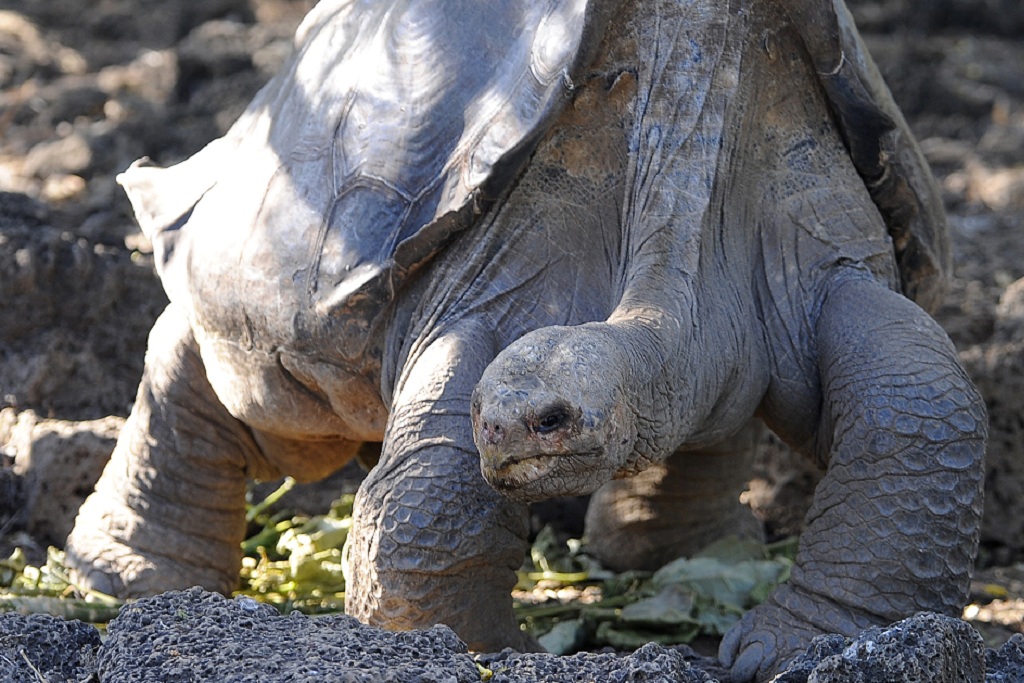
No discussion of the Fernandina tortoise’s near-extinction would be complete without addressing the broader ecological collapse caused by invasive species. The Galapagos Islands are one of the world’s most intact tropical archipelagos, but they are not pristine. Humans have introduced a rogue’s gallery of destructive animals:
-
Rats (Rattus rattus and Rattus norvegicus) – Arriving as stowaways on ships, rats devour tortoise eggs and hatchlings with horrifying efficiency. A single rat can destroy an entire nesting site in one night.
-
Feral Pigs – On several islands, pigs root up tortoise nests and kill juveniles. While Fernandina has no established pig population, nearby Isabela does, creating a constant risk of spread.
-
Fire Ants (Solenopsis geminata) – These aggressive insects swarm hatchlings as they emerge from eggs, biting their eyes and soft tissue until the young tortoises die from shock or infection.
-
Feral Cats – Originally brought to control ship rats, cats instead prey on juvenile tortoises, birds, and iguanas. A single feral cat can kill 30 tortoise hatchlings per week.
Fernandina’s extreme environment has partially protected it from some invasives pigs and goats struggle to survive there but rats and ants are present. This is why the decision to remove Fernanda from her natural habitat, while controversial, was ultimately sound. Her survival as an individual took precedence over an abstract ideal of “wildness.”
F. Searching for a Mate: The 2022 and 2025 Expeditions
One female does not make a population. Recognizing this, the Galapagos National Park organized follow-up expeditions in 2022 and again in early 2025. Each expedition included larger teams, drones equipped with thermal cameras, and additional scent dogs trained specifically for tortoise detection.
F.1. What They Found (and Didn’t Find)
The 2022 expedition covered approximately 70% of Fernandina’s accessible lowlands about 250 square kilometers. They discovered:
-
Old tortoise shells – Three weathered carapaces that, based on size and shape, could belong to Chelonoidis phantasticus. Unfortunately, all were too degraded for DNA recovery.
-
Fresh tortoise scat – Located near a remote lava tube system not previously searched. Genetic analysis of the scat confirmed the presence of a second, distinct individual. However, that individual has not yet been captured or photographed.
-
No additional live tortoises – Despite the scat evidence, the 2022 team failed to locate any other living specimen.
The 2025 expedition, still ongoing at the time of this writing, has deployed remote acoustic sensors to listen for tortoise movement at night. Preliminary reports indicate possible heat signatures in an inaccessible fissure zone, but confirmation is pending. Park officials remain hopeful but realistic.
F.2. The Reproduction Dilemma
If no other tortoise is found, Fernanda will die without offspring. Her species will then slide back into extinction. However, there is a controversial back-up plan: interspecies breeding. Genetic analysis shows that Fernanda’s closest relatives are the Volcán Wolf tortoises (Chelonoidis becki) from northern Isabela. Scientists are considering introducing a male C. becki to Fernanda, producing hybrid offspring. Those hybrids could then be backcrossed over several generations to recover C. phantasticus genes a technique called “genetic rescue through hybridization.”
While imperfect, this approach has been used successfully for the Floreana tortoise (Chelonoidis niger), which was declared extinct but later “recreated” using hybrids found on Isabela. Detractors argue that a hybrid is not a true species. Proponents counter that some DNA is better than no DNA.
G. Why This Rediscovery Matters Globally
The rediscovery of Chelonoidis phantasticus is not just a feel-good news story. It carries profound implications for conservation science, taxonomy, and public engagement.
G.1. The Lazarus Effect
Biologists use the term “Lazarus taxon” for a species that disappears from the fossil or historical record only to reappear later. The Fernandina giant tortoise joins an elite club that includes the coelacanth (a prehistoric fish found alive in 1938), the night parrot of Australia (rediscovered in 2013), and the Wallace’s giant bee (2019). These rediscoveries challenge the finality of extinction and encourage continued funding for survey work in remote areas.
G.2. Conservation Hope
There is a dangerous psychological phenomenon called “extinction fatigue” the numbing sense that losses are too great and too many to matter. Every rediscovery fights that fatigue. When a species returns from the dead, it mobilizes public donations, political will, and scientific interest. Since Fernanda’s discovery, the Galapagos Conservancy has seen a 40% increase in donations designated for tortoise protection.
G.3. Taxonomic Clarity
Many “extinct” species were described from a single specimen (a holotype) without genetic analysis. Modern genomics allows us to reassess these classifications. Some “extinct” species may be genetic variants of living species. Others, like Fernanda, are genuine evolutionary lineages that deserve protection. Accurate taxonomy is not academic navel-gazing; it determines where conservation dollars flow.
H. Lessons for Future Rediscovery Efforts
What can other conservationists learn from the Fernandina tortoise story?
-
Never trust extinction dates entirely. Absence of evidence is not evidence of absence, especially in rugged, under-surveyed terrain.
-
Invest in local ranger training. Jeffreys Málaga, the ranger who found Fernanda, grew up on Santa Cruz Island and had spent years tracking tortoises. Local ecological knowledge is irreplaceable.
-
Use multiple survey methods. Camera traps, scat dogs, drones, acoustic sensors, and ground teams all have blind spots. Combining them increases detection probability.
-
Prepare for immediate action. If a rediscovery happens, you must have a pre-approved plan for captive management, genetic sampling, and threat assessment. Fernanda was moved within 24 hours because the protocol already existed.
-
Manage expectations. Most “extinct” species will stay extinct. But the ones that reappear deserve every resource available.
I. The Current Status of Fernanda (As of 2026)
Fernanda resides in a dedicated enclosure at the Giant Tortoise Breeding Center in Puerto Ayora, Santa Cruz. Her health is monitored daily. She eats a diet of native plants, supplemented with calcium for shell integrity. She has not laid eggs, as she has no mate. Attempts to stimulate parthenogenesis asexual reproduction have failed, as expected for a species that reproduces sexually.
Her keepers report that she is alert, active for her age, and shows no signs of illness. Blood work indicates normal kidney and liver function. With proper care, she could live another 40 to 60 years. That is the window of opportunity for finding another Chelonoidis phantasticus or implementing a hybridization program.
The Galapagos National Park has designated Fernandina Island as a “priority zone for cryptic tortoise detection.” All visitors to the island (mostly scientists and authorized filmmakers) must now report any tortoise sightings, no matter how fleeting. The park has also increased penalties for introducing invasive species, including fines of up to $50,000 and possible imprisonment.
J. Conclusion: A Second Act for a Phantom Species
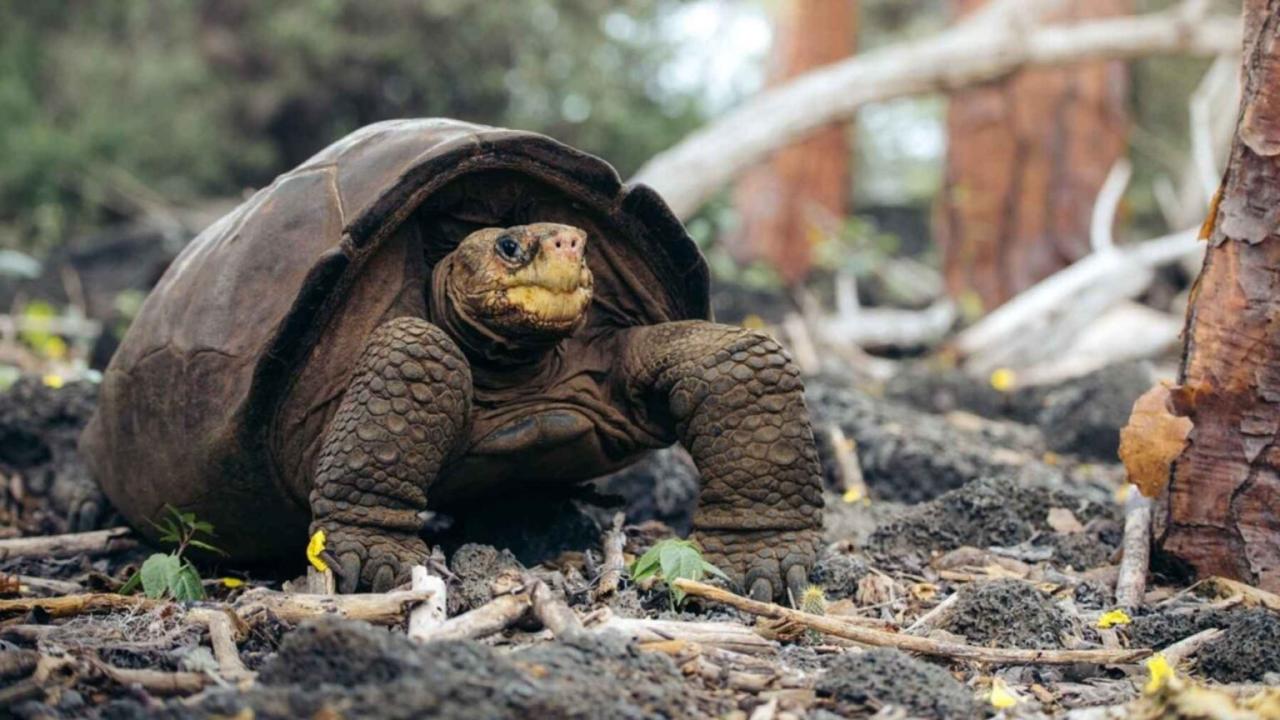
The story of the Fernandina giant tortoise is still being written. Its first act was tragedy: a unique evolutionary lineage driven to the brink by human activity. Its second act the 2019 rediscovery was a miracle of persistence and luck. The third act remains uncertain. Will Fernanda live out her days as the last of her kind, a living monument to extinction? Or will scientists find her companions hiding deeper in the lava labyrinths?
Regardless of the final outcome, this rediscovery has already achieved something remarkable. It has reminded the world that nature’s secrets are not all lost. In an era of biodiversity collapse, where headlines announce mass die-offs weekly, the reappearance of a ghost species feels like an act of rebellion. The Fernandina tortoise refused to follow the script. It declined the obituary. And for that defiance, conservationists, scientists, and everyone who cares about the living world owe it an enormous debt of gratitude.
The next time someone tells you that conservation is futile that species are disappearing too fast to save remember Fernanda. She waited 113 years to be found. She is still waiting for a companion. Her story is not over. Neither is ours.